The work is getting done. Deadlines are being met. The website looks good. But somehow, the client is frustrated — and you are not entirely sure why.
Often, the answer is not the work itself. It is the experience of working with you.
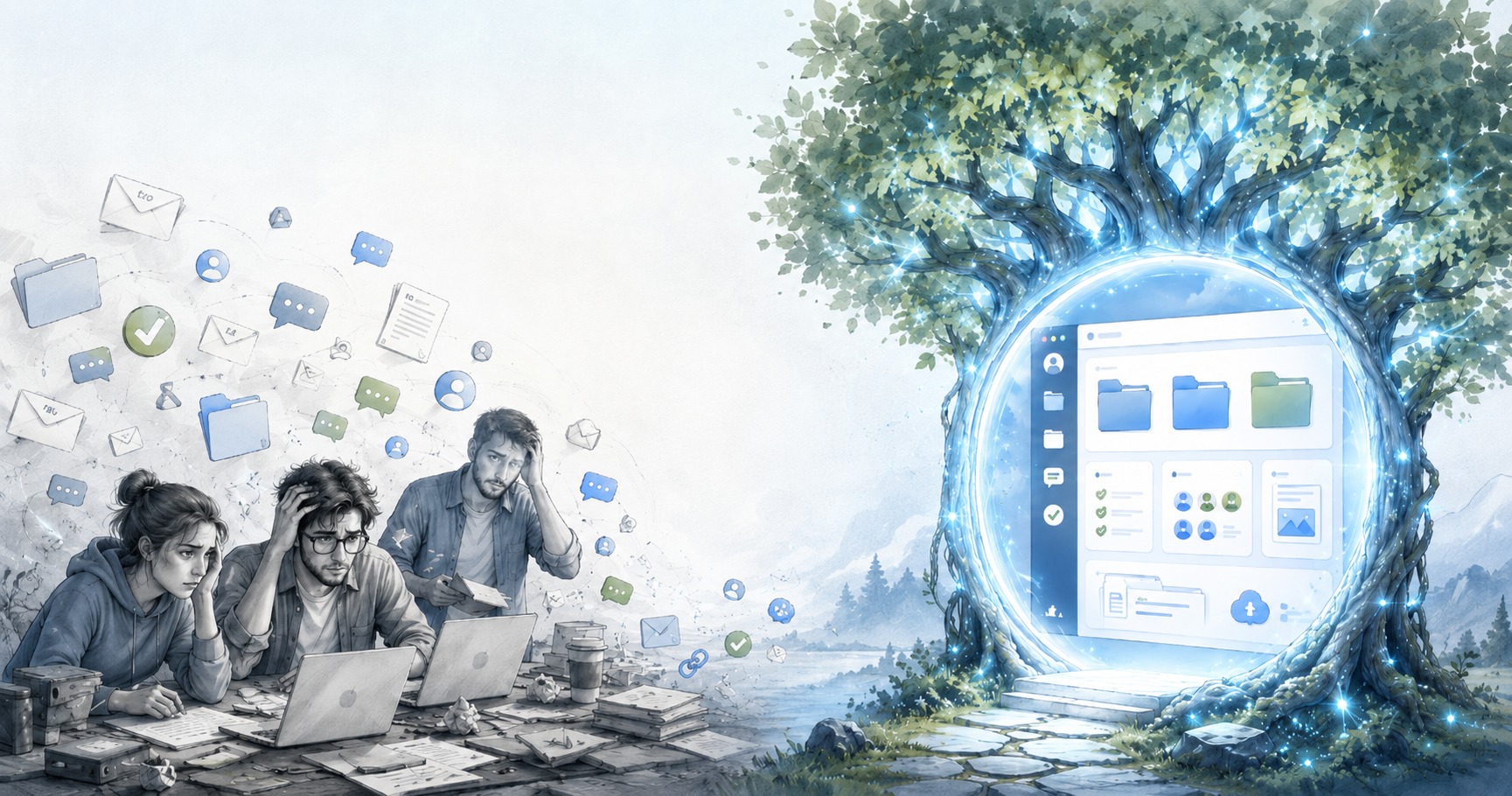
When communication is spread across email threads, text messages, Slack channels, shared drives, and random attachments with names like "final_FINAL_v3.pdf," something happens that has nothing to do with the quality of your output: the client starts to feel like they are doing the admin job you should be doing for them. That feeling erodes confidence. And eroded confidence makes clients leave, even when the deliverables were fine.
Missed Files, Forgotten Approvals, and Buried Requests
Every agency has a version of this story.
A client sent feedback on the homepage copy — but it came in as a voice note on WhatsApp. Someone flagged a logo change in a Slack thread that was also being used to discuss something unrelated. A contract approval was buried under twelve replies in an email chain that started three months ago about something else entirely. A file was shared in a Google Drive folder that a new team member does not have access to.
Nothing was malicious. Nobody was careless. The process just had no structure, so things slid through the gaps that structure would have closed.
The cost is not always visible in the moment. A missed approval adds a day to the timeline. A buried request means the client has to follow up, which they find mildly irritating. A lost file means someone spends forty minutes searching for something that should have taken forty seconds. These are not disasters individually. But they compound — across a project, across a relationship — into a general impression that the agency is disorganized. And once that impression takes hold, it is hard to dislodge.
Your client experience should feel as polished as the websites you build.
Why Clients Get Frustrated When They Do Not Know Where Things Live
There is a particular kind of frustration that clients rarely name directly but almost always feel: the frustration of not knowing where to look.
Where is the latest version of the sitemap? Was it in the Drive folder, or did someone email it? Is the feedback you gave last Tuesday reflected in the current design, or was that a different version? Who has the login credentials — were they in the onboarding doc or in that early Slack message?
When clients cannot answer these questions without reaching out to you, every interaction carries a small tax. A small tax on their time, yes — but more importantly, a small tax on their confidence. People do not consciously think "this agency is disorganized." They think "I always have to chase things down," or "I never know what's happening," or "it feels harder than it should be." The conclusion they draw is the same either way.
A client who feels informed and oriented is a client who trusts you. A client who feels like they are navigating a system designed for your convenience rather than theirs is a client who is already mentally shopping for alternatives.
How Scattered Tools Create Internal Team Confusion
The hidden cost of scattered communication is not only client-facing. It runs through your team as well.
When a new team member joins a project mid-stream, where do they get up to speed? If the answer is "you will need to read through the email chain, check the Slack history, find the Drive folder, and ask whoever has been running point" — that is a real cost. It is time spent on archaeology instead of work. And it introduces error: the new person misses context, makes an assumption, and something that should have been straightforward becomes a problem.
When a client request comes in through the wrong channel — a DM to someone's personal phone rather than a project inbox — it is entirely possible for that request to live and die on one person's screen. No visibility, no accountability, no paper trail. If that person gets sick or moves to a different project, the request vanishes.
Scattered tools create fragile processes. Fragile processes mean that the agency runs on individual memory rather than shared systems — and individual memory is exactly as reliable as the people holding it, under the exact conditions they happen to be in.
The Benefit of a Single Client Workspace
The fix is not software for its own sake. It is consolidation.
When a client has one place to go — one URL, one portal, one shared workspace — the dynamic changes. They know where the files are. They know where to leave feedback. They know where to find the timeline, the latest deliverable, the approval that is waiting on them. They stop having to ask. And the act of stopping asking changes how they feel about the engagement.
From the agency side, consolidation does something equally valuable: it creates a shared record. Every request, every approval, every version, every conversation — visible to everyone who needs it, regardless of who was online when it happened. New team members can get up to speed in minutes. Handoffs become clean. Nothing lives only in someone's inbox.
This is not about adding complexity. It is about removing the wrong kind of complexity — the invisible, accumulated complexity of everyone doing things slightly differently and hoping it holds together.
Why Organized Communication Makes an Agency Feel Bigger and More Professional
There is a perception effect that organized agencies understand and scattered agencies miss.
When a client receives a clear onboarding document, accesses a tidy shared workspace, gets updates through a consistent channel, and always knows where to find what they need — they experience the agency as competent, established, and trustworthy. It feels like working with a company that has done this before and knows what it is doing.
When a client gets a welcome email, then a Slack invite, then a Google Drive link, then a separate email with credentials, then a text asking if they got the Drive link — it feels like a small operation improvising as it goes. Even if the work is excellent.
This gap matters disproportionately in the early stages of a relationship, when the client is still forming their opinion of you. But it continues to matter throughout. Every touchpoint either reinforces the impression that you are a professional operation or quietly undermines it.
Clients pay a premium to work with agencies they trust. Trust is partly built on talent. But it is also built on every logistical interaction they have — every time they reach out and get a clear, consistent, organized experience in return.